Connect to multiple ecosystems
Connect to multiple blockchain networks and ecosystems in MetaMask at the same time using @metamask/connect-multichain.
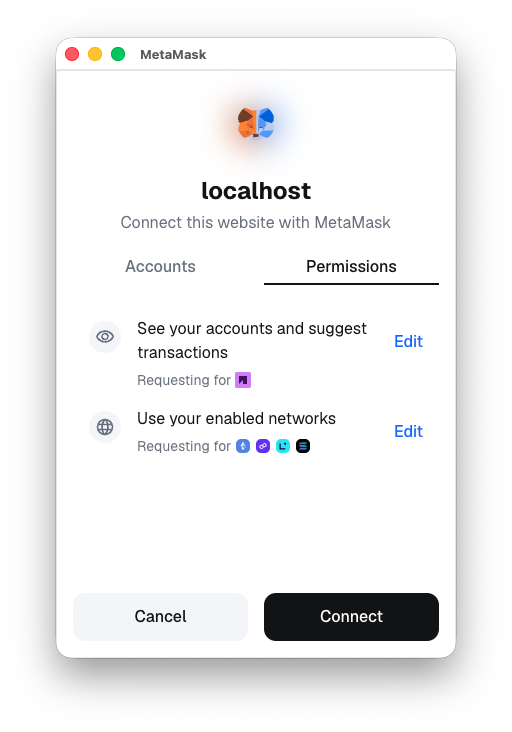
With the multichain client, your dapp can request access to EVM networks and Solana (and future ecosystems like Bitcoin and Tron) in a single connection prompt — no separate connect flows per chain. This gives you more control than the ecosystem-specific clients, but requires adapting your dapp to work with the Multichain API rather than traditional per-chain RPC.
How the Multichain API works
MetaMask Connect is built on the Multichain API (CAIP-25) specification, a chain-agnostic standard for wallet-dapp communication. For the full rationale and specification, see MIP-5.
Instead of connecting to one chain at a time, the Multichain API lets you:
- Request access to multiple ecosystems at once — for example, Ethereum Mainnet, Polygon, and Solana Mainnet in a single session
- Send requests to any chain in the session — send a Solana transaction and an EVM transaction through the same connection
- Manage the full session lifecycle — create, query, invoke methods on, and revoke sessions with
wallet_createSession,wallet_getSession,wallet_invokeMethod, andwallet_revokeSession
For dapps that support both EVM and Solana, this means one session covers both — and users see a single approval prompt.
Quick example
import { createMultichainClient } from '@metamask/connect-multichain'
import { address, createSolanaRpc } from '@solana/kit'

const client = createMultichainClient({
  dapp: { name: 'My DApp', url: 'https://mydapp.com' },
  api: {
    supportedNetworks: {
      'eip155:1': 'https://mainnet.infura.io/v3/YOUR_API_KEY',
      'solana:5eykt4UsFv8P8NJdTREpY1vzqKqZKvdp': 'https://api.mainnet-beta.solana.com',
    },
  },
})

// Connect with scopes across ecosystems — one approval for all chains
await client.connect(['eip155:1', 'solana:5eykt4UsFv8P8NJdTREpY1vzqKqZKvdp'], [])

// Get accounts from session
const session = await client.getSession()
const ethAccounts = session.sessionScopes['eip155:1']?.accounts || []
const solAccounts =
  session.sessionScopes['solana:5eykt4UsFv8P8NJdTREpY1vzqKqZKvdp']?.accounts || []

// Get ETH balance via invokeMethod
if (ethAccounts.length > 0) {
  const ethAddress = ethAccounts[0].split(':')[2]
  const ethBalance = await client.invokeMethod({
    scope: 'eip155:1',
    request: { method: 'eth_getBalance', params: [ethAddress, 'latest'] },
  })
  console.log('ETH balance:', ethBalance)
}

// Get SOL balance via @solana/kit (getBalance is not supported via invokeMethod)
if (solAccounts.length > 0) {
  const solAddress = solAccounts[0].split(':')[2]
  const rpc = createSolanaRpc('https://api.mainnet-beta.solana.com')
  const balance = await rpc.getBalance(address(solAddress)).send()
  console.log('SOL balance:', balance)
}
When to use the multichain client
The multichain client is a good fit when you're:
- Building a new dapp designed from the ground up for multiple ecosystems
- Looking for the best cross-chain UX — one connection prompt for all chains
- Needing full control over the session lifecycle
If you're adding MetaMask Connect to an existing dapp and want minimal code changes, the ecosystem-specific clients (@metamask/connect-evm or @metamask/connect-solana) are a simpler starting point — you can always migrate later.